
Bad publicity is back in the spotlight! While it’s never truly been out of the game, Vantage Point is the first set since Reign and Reverie to have bad publicity as a major theme. We’ve made some updates to modernize and clean up this mechanic for its return to prominence. I’m here on behalf of the NSG Rules team to talk you through the changes.
For newer players who haven’t seen bad publicity before, the Corp takes bad publicity counters to represent particularly scandalous behavior they’ve (allegedly) gotten up to. This doesn’t directly do anything to the Corp, but Runners can find more people willing to help them out when the Corp they are hacking is unpopular. The game represents this extra support with extra money: every time they start a run, the Runner gets access to 1 bonus credit for each bad publicity counter on the Corp. This money can be spent for anything the Runner needs during the corresponding run, but it’s lost if the Runner doesn’t spend it by the time the run ends.
Those basics are staying the same, but some of the details are changing in ways that experienced players should take note of:
- As of Vantage Point’s release, bad publicity credits are no longer placed in the Runner’s credit pool. Instead, there is a new designated location in the play area called the bad publicity fund.
- The bad publicity fund is filled at the start of each run and empties at the end of each run, just as the Runner would previously gain and lose bad publicity credits to their credit pool. The Runner can spend credits from the bad publicity fund during the run.
- All Corp cards that can give the Corp bad publicity in any way are receiving an update to give them the new liability subtype. This impacts about 30 past cards in total, but only 5 of them are in Standard. Check out the new NBN identity, Editorial Division, to see what we are able to do thanks to this new subtype.
- The illicit subtype is being retired, and will be removed from all 16 cards that had it.
Read on for an explanation of why these changes are happening. But first, I’m told you have to take an important business meeting…
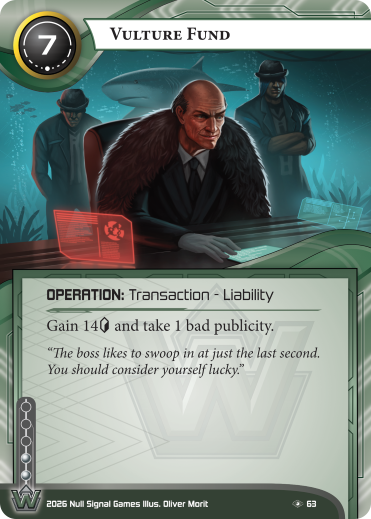
Vulture Fund
Weyland Consortium Operation: Transaction – Liability
Play cost: 7 – Influence cost: 2
Gain 14 and take 1 bad publicity.
“The boss likes to swoop in at just the last second. You should consider yourself lucky.”
Illustrated by Oliver Morit
Non-Fungible Counters
To establish some context for the bad publicity changes, let’s start with a case study of the history of Stimhack.
Stimhack is a beloved classic card of FFG-era Netrunner, but it’s a pretty weird card if you’re used to the way an ability like this would work today. According to Stimhack’s original printed text, it gives the Runner a bunch of credits directly to their credit pool, but those specific credits have special properties that make them distinct from the other credits there (namely, that they go away at the end of the run).
Following the instructions as given and actually mixing Stimhack credits in with the Runner’s other credits could easily become confusing, especially if the players needed to change out denominations of credit counters or if the run was particularly complicated. In practice, players would keep the Stimhack credits separate from their other credits by just putting them on the card itself.
It’s been a frequent point of feedback over the years that “special” credits feel weird. While technically the game can apply effects to individual counters (credits or otherwise), most players conceptualize their credit pool as just a number, and this expectation is deeply ingrained enough to cause a lot of friction when it’s challenged. Counters of the same type in the same game location should be fungible! If you ever consolidate 5 individual credit counters into a single 5-credit counter, track your Fermenter’s hosted virus counters with the faces of a d6, or shortcut advancing a card as Weyland Consortium: Built to Last by just taking a credit instead of explicitly spending 1 and then gaining 2, then you are implicitly making use of this property. It’s very handy!
Tracking Stimhack credits on the card itself is a good pragmatic solution, but it can still feel awkward to do something different from what an ability actually tells you to do. Ideally, card text is written to match the steps you actually take when you play the card. So in late 2019, version 1.4 of the Comprehensive Rules updated the official text of Stimhack to try to resolve this discrepancy, directly integrating the “put the credits on the card” solution.
Later cards like Overclock would continue to handle temporary credits by hosting them on the card that provides them, but you might notice that the updated Stimhack still looks pretty different from Overclock. Specifically, Overclock just gives the Runner permission to spend its hosted credits, whereas Stimhack says its credits are “considered to be in” the Runner’s credit pool. This “considered to be” wording is a way to let the Runner spend credits from Stimhack, but it has some additional implications: credits on Stimhack are affected by abilities that make the Runner lose credits, and they are included by abilities that check how much money the Runner has. Credits hosted on cards are normally excluded from both of these cases.
The subtleties of Stimhack credits aren’t especially intuitive, which is why we haven’t made any other cards that use the “considered to be” approach. It’s more direct to just have game components exist where they are and tell the player what they can do with them. But the functional differences between the two approaches do matter, so we also have no plans to change Stimhack to work like Overclock.
When we write card text updates, we are trying to find a balance among several competing factors, and pure simplicity isn’t the only one: we also want to maintain as much of the original behavior as possible, especially for cards with a lot of history where players are used to it working a certain way. And whether they have past experience or not, we expect that many players have printed versions of the card with its original wording, so we want the expectations they get from reading those copies to work out mostly correctly in play. Having to check the official updated text to answer questions or figure out unusual interactions is fine, but for “routine” uses of the card, the text players have in front of them should generally not be leading them astray.
Marked Accounts
Aside from playing Stimhack by its original text, there’s only one other way to get “special” credits in your credit pool: make a run while the Corp has bad publicity. Bad publicity credits have the same problems as Stimhack credits. As written, they break the expectation that counters are fungible, and the pragmatic way players manage them doesn’t match what the rules tell you to do.
But this time, the “special” credits aren’t coming from a specific card, so the pragmatic solution isn’t as obvious, and a variety of approaches have developed. Some players place credits on top of bad publicity counters and remove them or flip them over as they are spent, some players use double-sided bad publicity counters as credits and flip them over directly, and some players have found still other tracking methods.
With Vantage Point planning to introduce a larger focus on bad publicity than any previous NSG expansion, the Development and Rules teams decided it was time to see what improvements we could make. Everyone agreed that it was worthwhile to define a new location for bad publicity credits, separate from the credit pool, as long as it didn’t cause unforeseen problems. This change was introduced at the beginning of playtesting for the set, and the basic idea of “bad publicity credits don’t count as part of your credit pool” worked as smoothly as we’d hoped.
We also considered making other changes to the mechanic: some staff presented evidence of players having an intuition that the Runner should get an extra credit immediately if the Corp takes bad publicity in the middle of a run. But after a lot of discussion, it became clear that intuitions about bad publicity were far from universal, since tracking bad publicity credits had come to be handled in so many different ways. In particular, if taking bad publicity mid-run could affect the Runner’s bad publicity credits right away, then it became very unclear what should happen if the Corp removed bad publicity mid-run (a much more rare occurrence, but something that is definitely still possible).
Ultimately, this element of bad publicity was left unchanged: the Runner gets their payout at the start of the run, and changes to the Corp’s bad publicity from that point onward won’t impact them until the next run.
Similar Case Studies, Different Conclusions
So bad publicity credits now have their own separate home. Why did we make them work like Overclock credits instead of following the same approach from Stimhack? Or conversely, if a broader mechanic like bad publicity is changing, why are we leaving Stimhack the way it is?
The answer comes back to balancing competing factors. The big win here is that the new rule is simple and consistent with how credits behave when they are hosted on cards. Players don’t need to learn a bunch of separate rules for what kinds of credits can be lost to Valentão’s second subroutine or counted by its third subroutine. There are only two cases, and they handle all of these effects uniformly: “regular credits in the credit pool, yes” and “everything else, no”.
The consequences of not making a change are also more severe for bad publicity: Stimhack is just one card, and its use of an unusual structure doesn’t stop us from making future cards that work differently. But bad publicity is a keyword meant to interact with multiple other cards, so the only ways we can make future cards that improve on the status quo are to change how the mechanic works for all bad publicity cards, or make a brand-new keyword that doesn’t interact with older bad publicity cards at all.
Finally, it’s noteworthy that unlike Stimhack, where nearly all physical copies of the card tell you the credits are part of your credit pool, no cards have ever included reminder text for bad publicity or otherwise explained how it works right in their text. So players with old cards won’t be getting any contradictory information by reading them as-written.
Handling a Liability
Aside from how the mechanic works, the Development team also wanted a hook for abilities to be able to care about cards that can give the Corp bad publicity. Normally, our primary tool for grouping related cards is to use a subtype, and for most of playtesting, the ability on Editorial Division just referred to the existing illicit subtype. But as the set came together, multiple teams realized there were problems with continuing to use that subtype in a way that fit our needs.
First of all, the way illicit had been linked to mechanics over time was inconsistent. We wanted a grouping for Corp cards that give bad publicity, but only about half the FFG cards that fit that grouping had the subtype. Initially introduced in Spin Cycle, illicit was originally only given to ice that gives the Corp bad publicity when they rez it. Data and Destiny’s Reality Threedee wasn’t ice, but it had the same ability, so that was fair enough. But then Terminal Directive gave us Illegal Arms Factory, which has roughly the inverse ability (and though the card’s theme seemingly justified the subtype, the set also contained Illicit Sales, which was not illicit). By Reign and Reverie, the subtype was being put on almost every card that could give bad publicity (even though the black ops and gray ops subtypes already covered a lot of the same thematic ground for operations), but still not agendas.
We considered fully expanding illicit to cover all the cards we wanted to group, but this would have been a massive restriction on how bad publicity cards could be themed. Rather than bad publicity being associated with a variety of scandalous or unpopular activities, the word illicit only fits the specific case of Corp activities that are, well, illegal. Furthermore, plenty of cards represent illegal Corp activity that have nothing to do with bad publicity (for example, every black ops or gray ops operation).
Even more importantly, lots of cards are themed to represent individual people, and the implications of attaching the illicit subtype to a person—essentially, calling them “illegal”—are unacceptable. Both looking backward and considering characters going forward who we had plans to depict on cards interacting with bad publicity, it was clear we needed a different solution.
The Narrative team came up with liability as our new “bad publicity subtype”. It’s still evocative, but it fits a much broader thematic space, and while it still attaches a negative connotation to a character, personally I think it comes across with a strong sense of a specific perspective: this is corpo-speak, a classification an accountant or executive would assign based on some kind of cold risk analysis, not the way a regular person (even a bigot) would think of or refer to someone.
Once we had decided to introduce liability and add it to all the relevant cards, the last thing to figure out was what to do about the existing illicit subtype. We considered leaving it in place on older cards alongside the new subtype, but we decided there wasn’t much benefit to doing so, and that having both in some cards’ official text could be confusing or cause difficulty if someone wants to make an alt-art version of some cards that already have long type lines.
Succès de Scandale
The bad publicity changes were a striking instance of cross-team collaboration. It started from a fairly simple reform proposed by the Development team, but figuring out all the details and getting from that initial idea to where we ended up involved important contributions from just about every team in the NSG Studio. I’m very happy with how things turned out, and I’m excited for you all to see more of the misbehavior Corps will be getting up to in Vantage Point.
Vantage Point will be released on March 2. It will be available from our online store, our retail partners, and as a free print-and-play PDF immediately, and from our print-on-demand partners as soon as it’s approved.
