A lot has changed here at Null Signal Games in the past year, and our Design and Development teams’ processes are no exception. Vantage Point is the first set produced through these new processes, and as such it’s been a key opportunity for our designers and developers to check back in with the core philosophies that drive their work on the game. We sat down with Ams (Associate Developer), Safer (Development Team Lead), SkoolKnight (Deputy Design Team Lead) and Zoe (Design Team Lead) to discuss Vantage Point, the Standard format, and a new card that they hope might fulfil some of their dreams for the format.
The Project of Vantage Point
Unlike many of our sets, Zoe tells us, Vantage Point was designed specifically to fill out constructed formats, primarily Standard, rather than being developed from a narrative or thematic starting point. Its aim, in short, is to continue the “overall project of Elevation”.
The group we spoke to agrees that Elevation has been broadly successful in ushering in the large-scale rotation of the last FFG-produced cards remaining in Standard. However, during playtesting for that set it became apparent that more work was needed to provide the format with a stable base going forward. Vantage Point continues that work, building up a comprehensive set of staples for a healthy, functioning Standard format. We needed that strong foundation, Zoe says, before moving onto more weird and wonderful narrative-driven sets in the future.
So how exactly do we build that foundation? SkoolKnight outlines some more specific goals that guided the set from the Design team’s perspective:
- Support scoring Corps: “We wanted to give each Corp faction a powerful, unique and ideally fun way to have access to a scoring gameplan”.
- Expand Runner deck diversity: “We aimed for lateral shifts in Runner power level, to bring out cards that have sat in the binder, improve archetypes that have suffered from rotation, and empower identities that never received the support they deserved”.
- All that work is bounded by a desire to “create an elegant set that learned from Netrunner’s past” and that “let us work with agility and quality in the new workflow”.
Ams cites Flood The Market, her favourite card from the set, as a key example of these goals in action—an elegant, unique, fun card, with a good depth-to-complexity ratio, that single-handedly creates a new scoring Corp archetype. In her words: “I can’t wait for it to get banned!”
Card Do One Thing
That question of depth vs complexity leads us onto our next topic: how do Design and Development manage complexity in individual cards to keep the game as a whole clear and understandable?
Ams provides us with a quick history of changes in the Development team’s philosophy on this topic since the release of Rebellion Without Rehearsal. It was shortly after that release that she and some other new members joined the team, and that injection of new ideas resulted in the creation of a few key mantras for future development work. One of those was focused on complexity: ‘Card Do One Thing’.
Of course, she explains, that doesn’t mean that every card should only have one ability. She gives Mycoweb as an example — yes, it has four subroutines, but taken together they represent a single concept: the lifecycle of a piece of ice, from being installed to being rezzed to resolving subroutines. Ams outlines a rule of thumb for working on cards: “If a card does lots of different things that you can’t hold in your head, then the card isn’t real.”
Not every card passes that test, even though it may have been designed to fulfil a specific role. Privileged Access, for example, fills the role of a recursion card, but in practice it is hard to explain its four clauses and multiple qualifiers in a unified concept. It recurs resources, and also sometimes programs, and also gives you a tag (but also tells you not to be tagged). Cards like this are often victims of what Ams calls the “complexity death spiral”. A card that isn’t working in as expected starts to get caught in the spiral if developers keep stapling on new conditions, rather than stepping back to holistically reassess what role the card is intended to play.
This has been a useful lesson for Design as well as Development, Zoe tells us. Their takeaway has been to try to hand over the simplest version of every card design to Development for their balancing work. Dialling in the specifics of the final card generally adds complexity, so starting from a place of maximum simplicity helps prevent “complexity death spiral” situations.
This approach has real rewards, helping incept cards like Flood The Market: “Just because a card has a single effect doesn’t mean it only has a single application”, Zoe says. “Cards that are easy to understand but can be applied creatively – that’s gold.”
A Healthy Standard Format
In addition to working on individual cards and determining the aims of whole sets, Design and Development also play a role in creating the play experience of our supported formats—most prominently Standard. The community at large often talks about the ‘health’ of Standard, as an analogue for how fun and engaging they find the format. So we ask our group of designers and developers: What does a ‘healthy’ Standard format look like to you?
SkoolKnight kicks us off, providing some insight into the criteria and metrics he uses to track the health of Standard as a designer. In his mind, a healthy Standard should have:
- Diverse deckbuilding and representation: Players can be self-expressive in deckbuilding. There is plenty of novelty to be found in creating Standard decks.
- Appropriate support for different win conditions: The various win conditions and other core gameplay pillars of Netrunner are well supported, and supported in the right proportions. Scoring is a primary way to win for both sides, but there are plenty of alternate ways to win. Runners can do diverse proactive things, and Corps have interesting and compelling ways to react and respond.
- The emotional experience of play is rich and compelling: Players perceive the game as fun and exciting based on their direct experience of play. Effects and interactions in the game create moments that players want to talk about afterwards, win or lose (SkoolKnight calls this “Moment-first design”).
- Games aren’t over until they’re over: Even when they’re behind, players have a way back into the game, a vector to interact. Even when they’re losing, “players can have a wonderful time right up until their very last click”.
Zoe adds that one of Design’s key goals for Standard is to provide options, making sure that a wide range of archetypes are available to players, even if not all of them are top-tier competitive. “We never want someone to feel like they cannot fulfil the core fantasy they’re looking to Netrunner for.”
For the Development team, however, the aim is a little different. Safer says that he looks at format health “almost exclusively through the lens of ensuring certain cards or interactions don’t become a problem”. What makes something a ‘problem’? Obscuring the “phenomenally fun” core systems of Netrunner. For Safer, it is the role of Development to make the game fun by making sure the cards “don’t get in the way”.
Development has learned some specific lessons in this vein during work on the past few sets. For example, one key takeaway was that bounce-back economy options on the Corp side need to be tightly controlled—if it’s too easy for Corps to recover from low credit totals, Runners’ ability to apply pressure is undercut, and the dynamism of the game plummets.
Safer notes that there is a natural tension between these aims of the Design and Development teams. Design works to add plenty of new ideas to the game and push boundaries in their quest for variety and emotional impact; Development works to test those boundaries, finding out which ideas go too far and which can be allowed to push at the limits of format health without breaking them. The group agrees that this internal conflict, which in SkoolKnight’s words “puts novelty in tension with stewardship”, is very productive!
So what is it that we talk about when we say we want Standard to be ‘healthier’? This discussion provides an answer: we want cards, mechanics and emergent gameplay that point us towards the incredibly fun core mechanics of Netrunner!
Addressing Side Balance
One of the common concerns raised about Standard since Elevation and the accompanying rotation, within NSG and in the wider community, has been about side imbalance. Value-focused Runners have been consistently able to outmuscle many scoring Corp archetypes, forcing Corps into greater reliance on alternative gameplans. How exactly do Design and Development try to approach the question of side balance?
The first step, Safer tells us, is acknowledging that it’s an incredibly hard problem! Conceptualising what the game would look like when both sides were appropriately balanced is already a challenge; finding ways to measure that and then design towards it is even harder. In fact, Development have broadly concluded that it’s too complex of a problem for them to try and address directly in playtesting.
Zoe cites Rashida Jaheem, and the problems its rotation created for the format, as a key example of why side balance is so difficult in practice. “There’s a core tension between designing for side balance and trying to avoid cards being format-warping.” While a single powerful card might bring the power level of its side up to a more balanced level in the short term, long term it has a lot of repercussions that are hard to deal with. As Zoe puts it, “Rashida was f***ed up, but now we need to give Corps a lot of things for them to be able to live without it.”
This need to make sure that side balance isn’t just the purview of a handful of cards means that trying to address it directly with a single set is a risky business. Instead, Safer says, Development uses established design principles along with their learned best practices to create a “rich” Standard environment.
The Standard Balance Team balances the format with subtractive tools, but they can’t do that unless the cards we’re making add a lot of options for players in the first place. A “rich” environment is one that is dense with possibility, giving players plenty of opportunities to address problems that arise on one side with varied strategies on the other—and giving the Format teams plenty of tools to do their work with. Simply put, Ams adds, “we make sure we are printing things that can be banned or allow other things to be unbanned.”
Dreaming of a New Standard
“The game is best”, Ams goes on to say, “when the Corp can shape what the game looks like.” Is this a score-out game or a flatline game? Will agendas be fast-advanced and scored straight from HQ, or scored out slowly behind a glacier of imposing ice? The variety of Corp archetypes available in Netrunner are a huge part of what makes the game so endlessly replayable.
But when the game gets too Runner-sided, Corp strategies that can’t keep up with maximum-value Runners get pushed out, and parts of the game get closed off to players. At times, that has been many players’ experience of current Standard. So a big aim of Vantage Point was answering the question ‘How can we let Corps do things?’
Let’s take a look at one of the key answers Design and Development dreamed up:
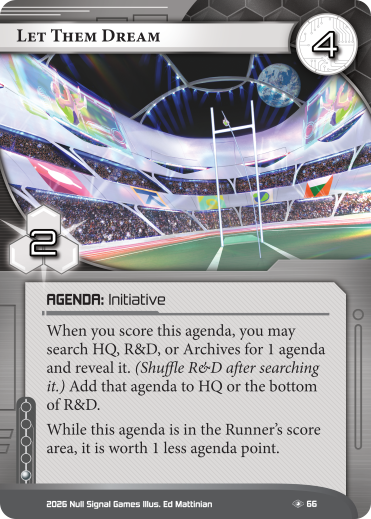
Let Them Dream
Neutral Agenda: Initiative
Advancement Cost: 4 – Points: 2 – Influence cost: 1
When you score this agenda, you may search HQ, R&D, or Archives for 1 agenda and reveal it. (Shuffle R&D after searching it.) Add that agenda to HQ or the bottom of R&D.
While this agenda is in the Runner’s score area, it is worth 1 less agenda point.
Illustrated by Ed Mattinian
Let Them Dream was not part of the first iteration of Vantage Point, Safer tells us. It was added when it became clear from early testing that scoring Corps were still struggling to keep up with Runners, even when the Corps were playing new Vantage Point cards and the Runners weren’t.
Vantage Point-empowered Corps could use new tools to establish a compelling scoring plan that threatened to win games, but Runners were still able to win consistently by taking advantage of Corps’ lack of ability to defend central servers. Development looked to the game’s history for potential solutions, and decided to re-explore ground first trod by the iconic agenda Global Food Initiative.
First, they wanted to understand how exactly Global Food Initiative did so much to help scoring Corps during its time in Standard. A 5/3 agenda with a similar ability—reducing the point value of the first copy stolen—was added to the set in testing. It played out as expected, reducing point density in central servers and therefore decreasing the chances of Corp losses feeling like they were primarily a result of variance.
However, Design was keen to ensure that this new agenda didn’t create the same play patterns as its predecessor. Zoe points out that she is always keen to explore the question of which effects are core to the game and which can be molded into different shapes to allow for new play patterns. Malleability is much more valuable than rigidity—the joint project of Elevation and Vantage Point would be a failure if the best decks ended up looking very similar to those from before rotation.
SkoolKnight notes that there was also a tension between designing Let Them Dream to slow down Runners’ approach to victory, which would in turn help address the struggles Corps were facing in playtest, and safeguarding against it slowing down the whole game too much.
To reflect these concerns, Let Them Dream was changed from a 5/3 to a 4/2 pretty soon after its introduction. This immediately changed how decks that used it were built and played. Global Food Initiative automatically allowed Corps to reduce both point density and agenda count by giving them a ‘safe’ 3 point sink. Let Them Dream also reduces centrals variance inherently, but only allows the Corp to also reduce the number of agendas available to the Runner if they get proactive and score it.
“Like Spin Doctor,” Safer says, by way of wrapping up our conversation, “Global Food Initiative was in some ways a patch on the core systems of Netrunner. If we redesigned the game from scratch today, we might make some changes to how many agenda points are required. Vantage Point was an opportunity for us to look at those core systems again and do the patching to reaffirm the game’s core foundation. That’s one of the key reasons why Let Them Dream has its place in the set.”
So as you start to explore the cards of Vantage Point in Standard over the coming weeks, dream big! On Luna, after all, not even the sky is the limit.
Vantage Point will be released on March 2. It will be available from our online store, our retail partners, and as a free print-and-play PDF immediately, and from our print-on-demand partners as soon as it’s approved.