It’s time for a new Balance Update for the Startup format, to coincide with the release of Vantage Point. This balance update is intended to be legal for Startup events run in the new Vantage Point card pool.
As of March 2nd 2026, the sets legal in the Startup format will be System Gateway, Elevation and Vantage Point. The Liberation Cycle — made up of The Automata Initiative and Rebellion Without Rehearsal — is no longer legal in Startup.
Summary of Startup Balance Update 26.03 Changes
Let Them Dream – Banned
Mercia B4LL4RD – Banned
Seamless Launch – Banned
Pharos – Unbanned
Corp decks have the following deckbuilding restriction: A Startup Corp deck can only contain a maximum of 3 agenda cards with a printed agenda point value of 3 or greater.
Explanation of Changes
Tightening the Agenda Restriction to Three Copies
With rotation pushing a number of 3-point agendas out of the format, we feel it’s important to reduce the restriction back down to three copies in the interest of faction equity and to act as a further balance lever on the available agenda densities Corps can rely on.
Let Them Dream
If you haven’t seen Let Them Dream yet, you can check out the preview article about it!
To understand why we have chosen to ban Let Them Dream in Startup on release, you need first to understand the reasoning behind the format’s agenda density rule:
Startup Corp decks are subject to the following deckbuilding restriction: A Startup Corp deck can only contain a maximum of 3 agenda cards with a printed agenda point value of 3 or greater.
This rule was introduced to combat a particularly powerful style of deck in the format: a 40-card minimum deck size identity with only six agendas, each worth 3 points. This style of deck has seen disproportionate success in the format since the rotation of the Borealis Cycle, and is caused by the generally lower amount of consistent multi-access that is available in the format, and the more limited options for contesting well-defended remote servers. It is generally possible for most Corps to invest in heavily defending one server, typically their scoring remote, just with the tools present in the core set. For this reason central server vulnerability matters that much more than in other formats.
To talk concretely about what the agenda restriction does, we must introduce a mathematical concept, “mean number of accesses to win” (M#). This number is the number of random accesses off of the top of R&D that a Runner player would need to take against a given Corp in order to win the game, on average. This doesn’t mean reaching that number will win the game; sometimes the Runner will need to access more cards, but often the number needed is actually much lower. If the Runner figures out that a card on the table is an agenda and steals it, then they get a much better chance of winning than they would by just taking random accesses on R&D.
Let’s begin by looking at some situations players will be familiar with, with values calculated using multivariate hypergeometric tail-summing:
| Total Cards | 3-point agendas | 2-point agendas | M# |
| 44 | 6 | 0 | 19.2 |
| 44 | 2 | 6 | 16.8 |
| 49 | 6 | 1 | 18.8 |
| 49 | 2 | 7 | 17.1 |
Note that if the Corp keeps a hand with no agendas in it, M# for that game will be decreased by around 2 independent of other conditions.
As you can see in the above table, introducing a restriction on the number of 3-point agendas meaningfully reduces the mean number of accesses to win, especially at the start of the game. In testing, shifts of a little over 1 in M# made a huge difference in the ability to play a central-focused Runner game plan, and that difference only increases as the game progresses and R&D gets thinner.
Now let’s look at what’s possible with Let Them Dream!
| Total Cards | 3-point agendas | 2-point agendas | Let Them Dream | M# |
| 44 | 2 | 3 | 3 | 19.9 |
| 49 | 2 | 4 | 3 | 19.8 |
As you can see, with Let Them Dream it’s possible to achieve M# values higher than the infamous 6x 3-point agenda decks without going over the agenda restriction.
What happens gets even more extreme when actually playing the game. Say you are playing a fast Haas-Bioroid: Precision Design deck. Your deck has two 3-point agendas and six 2-point agendas. There are 34 cards left in your deck, and you successfully score out a 2-point agenda with a 3-point agenda still in HQ. This is a fairly plausible game state. In this game state you would have an M# of 17.5.
Now instead let’s replace three of those 2-point agendas with copies of Let Them Dream and play out the same scenario, using the on-score ability to put a 3-point agenda that is in your deck on the bottom. Now your M# shoots all the way up to 23.8.
This jump from 17.5 to 23.8 represents an insurmountable level of safety in R&D that is impossible for most Startup Runners to overcome. It is for this reason that, while we would prefer to have all cards in Vantage Point be playable in Startup as a celebration of the set, we must ban Let Them Dream on release in the Startup Format.
Pharos
The Pharos Ban was in large part a product of Logjam and Tree Line adding too much consistency to getting many large heavily advanced, expensive barriers on the table too quickly. With the rotation of Logjam and Tree Line out of Startup, we are happy to return Pharos to the cardpool.
Mercia B4LL4RD and Seamless Launch
Haas-Bioroid is an absolute powerhouse of a faction in the core sets, with Precision Design and LEO Construction consistently proving themselves to be the most effective decks. It should be no surprise then, with Startup dropping to the closest to just System Gateway + Elevation it has ever been, that we must turn a keen eye onto keeping the power of the faction in check—especially with HB receiving a new suite of tempo management tools in Vantage Point.
We wanted to target the power of those decks, as well as scoring decks more generally, in light of some cards that have not yet been previewed. To achieve this, we don’t want to undermine the core defensive strategy, but instead tackle one of its greatest strengths.
We want to make it so that if the Runner does find the opportunity and invest the resources into getting in and dismantling the remote server, they can feel confident that they’ll be rewarded with agenda points. Removing Seamless Launch cuts the number of ways to avoid telegraphing the presence of an agenda substantially, meaning more often the HB player will need to pre-advance their agenda and advertise its presence. To avoid this telegraphing, HB players might resort to playing more 3/1 and 3/2 agendas, which comes with additional deckbuilding and power-level cost.
In order to further empower runners to contest the remote when they think it matters, we feel it’s important to increase the cost LEO has to pay in order to end the run, requiring the sacrifice of ice rather than an upgrade that already becomes less useful in the late game.
All Aboard The Luxury Line
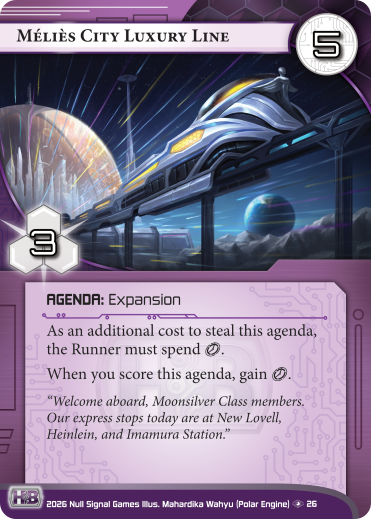
Méliès City Luxury Line
Haas-Bioroid Agenda: Expansion
Advancement Cost: 5 – Points: 3
As an additional cost to steal this agenda, the runner must spend .
When you score this agenda, gain .
“Welcome aboard, Moonsilver Class members. Our express stops today are at New Lovell, Heinlein, and Imamura Station.”
Illustrated by Mahardika Wahyu (Polar Engine)
Méliès City Luxury Line is one of those new HB scoring tools! Combining a powerful tempo restriction that narrows the scope of the Runner’s ability to contest remotes with a tempo boost that helps propel the Corp forward after they score it, we expect this card to be a mainstay for Haas-Bioroid decks in Startup.
Startup Balance Update 26.03 Full Contents
Corp
NBN: Reality Plus – Banned
Let Them Dream – Banned
Seamless Launch – Banned
Mercia B4LL4RD – Banned
Corp decks have the following deckbuilding restriction: A Startup Corp deck can only contain a maximum of 3 agenda cards with a printed agenda point value of 3 or greater.
Runner
Cleaver – Banned