Let’s make an exchange shall we? An exchange of stories. For it is rare to see another soul in Moonsilver class, least of all a patron of ours.
I have a tale from the backrooms of a ruler. It is ill suited as a greeting gift. Too sharp in detail, too blunt about the realities of their early days. But perhaps you can put it to better use. And, in return, tell me your tale.
This is a story of how we tried solve a difficult problem faced by the megacorp NBN:
How do we translate NBN’s economic advantage into real scoring pressure without creating non-games or a constant mental tax?
The answer was a journey of trials and errors, before converging into the crystal that you now see. I hope you enjoy this tale until we reach our stop.
Act 1 – A Swing and a Miss
◆ The Auditor
====
NBN Asset
—-
Cost: 1, Trash: 4, Influence: 1
—-
The Runner cannot spend credits from outside of their credit pool to pay trash costs.
The Auditor was one of our early attempts at shaping the mold. We envisioned an asset that served as an engine for the flagship archetype of NBN: taxing assets. We hoped it would make the board sticky despite the Runner’s many sources of income, giving room for the assets deck to breathe. That, however, was nothing more than a fleeting dream.
In the hands of playtesters, it served more as a targeted answer than the reliable, load-bearing engine we wanted it to be. It was shaky, narrow and became the single point of failure for the archetype—a silver bullet pretending to be an engine.
It was around this time that we took a hard look at the state of NBN as a whole. A common thought echoed through the halls of discussion: in a post-trace world, NBN had lost its cleanest ways to make being richer matter. And so we pivoted our search for a solution to focus on finding a more broadly useful economic pressure tool.
The talent scouts went out, seeking someone whose methods would convert economic advantage into defensive tempo and scoring pressure; someone whose principles would be clear and predictable from both sides of the table.
Act 2 – Controlling our Finances
◆ The Magistrate
====
NBN Asset: Executive
—-
Cost: 2, Trash: 4, Influence: 3
—-
The first time each turn an agenda is stolen or scored, add an installed Runner card to the grip unless the runner spends credits equal to the threat level.
Paying homage to a very popular instructor, we drafted an executive that does their work during game-deciding moments—when agendas change hands—applying increasing pressure as the game escalates.
In practice, however, they were more of an inconvenience than an injunction; a hand outstretched, demanding the Runner’s lunch money after they pulled off a bank heist. When the trigger did matter, it often mattered late, and when it mattered late, it was conditional on the executive being left on the board to persistently bombard the Runner with payment requests. Some playtesters even found themselves second-guessing old fears, admitting the Magistrate was “a lot less scary” than the instructor they remembered, relieved that the Corp couldn’t invest more credits to turn the screw.
So we rewrote the executive from ground up, honing them into a gatekeeper who knows how to exploit opportunities when they see them. We still hoped that the threat-driven consequence would ensure their relevance throughout the course of the game. The next draft marked the first time the executive carried more authority than nostalgia.
Act 3 – Gatekeeping our Agendas
◆ The Magistrate
====
NBN Asset: Executive
—-
Cost: 1, Trash: 3, Influence: 3
—-
The Runner cannot steal agendas if they have 4 or fewer.Whenever an agenda is scored or stolen, the Runner loses credits equal to the new threat level.
In this iteration, the Magistrate stopped asking for reparations politely during scheduled visits and instead posted as a guard at the corp’s gate. Have enough credits, or you don’t get to take it.
It worked, in the blunt and crude way an iron gate works. With a hard line in the sand, if the Runner’s credit total was too low, agendas will not leave the Corp’s servers. Paired with the threat-scaling penalty, the Magistrate turned scoring into proactive beatdown, which rewarded them for scoring more thanks to the threat text.
Playtesters commented that the gatekeeping didn’t feel like pressure so much as removal of permission. The experience was uniquely miserable: you were there, touching the agenda, you had earned it, but the Magistrate said “no,” and the rules reached in to take the moment away. Furthermore, like the ghost of the Auditor, the wording dragged us back into “credits weren’t in the right place” moments, when bad publicity and hosted credits suddenly felt like lesser coins, spendable everywhere except where it should have mattered.
These reactions weren’t rare. Some playtesters called this iteration oppressive even when the Corp wasn’t doing anything exotic, because of the two-for-one effect. Others described it as a matchup-defining question that a less flexible deck couldn’t answer once they fell behind.
Within the team, the discussion morphed into something more fundamental: Runners expect to be able to interact. The hard “you cannot steal” clause not only taxes the runner but also denies the premise of running in the moment the game is most alive. The same number would have felt fairer when phrased as an additional cost rather than a locked door, allowing payment through multiple sources and encouraging different lines of play.
We allowed ourselves to start strong with the Magistrate as we knew we were printing some Corp power in this set, and this asset was meant to be one of the loud ones. Then came the familiar Development march of tweaking numbers. We tried to make it more interactable by adjusting the rez and trash cost. We adjusted the “safe” threshold to make it more consistent with other thresholds. We increased influence to keep it from being everyone’s problem. But after rounds of “what if we tweak it like this,” the uncomfortable truth was obvious: we were polishing a durian that some people couldn’t stand to smell. The gate did its job too well.
If a credit check creates a loss of agency but scaling punishment creates volatility, then perhaps the only honest path is to let the Corp buy the pressure upfront, explicitly and predictably. Since we are testing strong, we thought, let’s make this a straightforward 1-to-1 exchange.
Act 4: Messages in numbers
◆ The Magistrate
====
NBN Asset: Executive
—-
Cost: X, Trash: 4, Influence: 4
—-
When you rez this asset, place X power counters on it.As an additional cost to steal an agenda, the Runner must pay 1 for each hosted power counter.
Whenever an agenda is scored, the Runner loses 1 for each hosted power counter.
September 13th was the day the Magistrate reached mythical status among playtesters. Paragraphs were written, memes were made. We had handed NBN a lapis philosophorum, an executive who could transmute raw credits into a win with the flip of a card. Corp enjoyers rejoiced at being able to trample over the Runner, striding towards victory with undefended agendas whilst the runner sat opposite, hollow-eyed, clicking for credits in penance.
Playtesters did what they do best: proving, with enthusiasm and zest, that the Magistrate could not be allowed to exist in this form. Yes, we expected the synergy with Bladderwort. Yes, we expected it to be good. But playtesters revealed that this version of the Magistrate could easily fold the Runner in half all on their own. Replay after replay of Corps paying astonishing amounts of credits to hire the exec, or throwing an early Magistrate into Archives just to rez another at three times the price point. It became a blasphemous ritual. All the Magistrate needed to work their magic was enough cash and an agenda to score. After that, it could handle the rest of the game, whilst the Corp leisurely watched the news cycle reporting an unprecedented number of credit crashes. It was, as one playtester drily noted, “wild as f***”.
The Magistrate was not theoretically unbeatable, but demanded something brutally specific from the Runner: to keep pace on credits for the entire game against a rich Corp, whilst not letting any agenda slip through the cracks. The punishment for slipping once was a cliff, as the drain and tax compounded into a loop that felt less like play and more like gravity. As a tester summarized it, “it’s dangerous to give a Corp the tool to convert money into a win at such an equivalent rate.” Money is power – those are the sacred words within the corporate scriptures. We need not make destiny so easily purchasable.
Luckily the fix was relatively straightforward: bind the effect into a single consistent number instead.
Act 5: The Final Verdict
Once we bound the effect, all that was needed was the familiar cycle of nudging and weighing numbers. With the tax fixed, the Magistrate stopped rewriting fate and applied pressure as we desired, squeezing the Runner through tithes, leaving small gaps for them to breathe, bluff and wrestle their way back.
Playtesters were, if not joyous, at least relieved upon the arrival of the new Magistrate. The feedback shifted from doom foretold to practical craft. We flirted with increasing the rez cost to 3, matching the other numbers on the card, but striving for elegance alone is a poor trade if it risks blunting the impact the Magistrate was designed to have. After all, armed with knowledge from the early days, playtesters had found synergies that we wanted to preserve. Some of the popular lines were to include ~~₰~~ in ~~₰~~
…
It seems the editors have deemed me to have spoken too much. With my stop rapidly approaching, you will have to explore this gift in my absence.
May the Magistrate and their tale bring you victory in many a contest. And when the dust settles, send them your dreams of the future in return.
They will be listening, beneath northern skies.
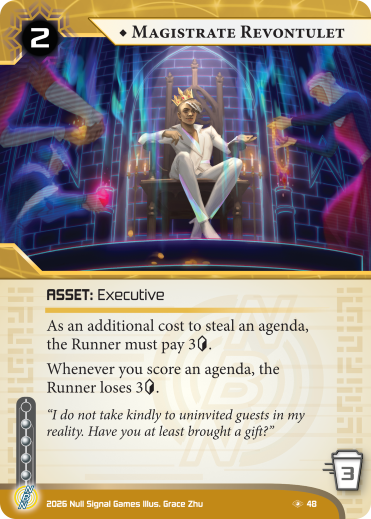
⬩ Magistrate Revontulet
Unique NBN Asset: Executive
Rez cost: 2 – Trash cost: 3 – Influence cost: 4
As an additional cost to steal an agenda, the Runner must pay 3.
Whenever you score an agenda, the Runner loses 3.
“I do not take kindly to uninvited guests in my reality. Have you at least brought a gift?”
Illustrated by Grace Zhu
Vantage Point will be released on March 2. It will be available from our online store, our retail partners, and as a free print-and-play PDF immediately, and from our print-on-demand partners as soon as it’s approved.