
Hello! My name is David, I joined Null Signal Games in January to update the new player experience for Netrunner. Today, I am excited to announce two of the projects I have been working on. First, a new “Learn to Play” video series. And second, an update to the in-person Learn to Play experience, with new scripted Learn to Play decks and an updated script.
Learn to Play Video Series
This video follows a 3-turn example game which covers the basic concepts required to play your first game of Netrunner. It serves as a short introduction to what Netrunner is and how it works. The narration and video editing were done by the incredibly talented Zarthbenn whose excellent visuals highlight key components of cards and make challenging concepts, like using icebreakers, easier to understand. Enjoy learning how to play Netrunner while listening to chill beats composed by Tripp Mirror! Put more sounds like these in your earholes by checking him out on Bandcamp!
We are currently planning another video in this series, which will cover many more concepts and in greater depth. The example game video serves as an introduction to Netrunner and its core mechanics. Together, these videos will give players a more complete introduction to the rules and demonstrate the flow of a game in action.
Learn to Play Deck Update
When I tried the current Learn to Play decks, I was inspired by how well a scripted game solves many of the most difficult parts of learning to play Netrunner. You have to explain very little up front, you can put cards in hands quickly, and you can teach by example. The script controls for randomness and handles hidden information for the instructor. We’re now slightly updating the decklists and the script to make even better use of these great teaching tools.
If you are teaching someone brand new to Netrunner, teaching via the scripted game is a great way to cover the core concepts and get someone playing on their own quickly. I now always keep a copy of these decks on me when I go to local meetups and I encourage anyone looking to grow their community to Print & Play or build a set of them. The example game video is a great place to start as it takes the same actions as the new script.
These decks were also designed to function well as “duel decks”. If the person you are teaching already has some experience with Netrunner, simply shuffle up and play to 7 points (or flatline)! This flexibility means that with one pair of decks you can introduce Netrunner to someone for the first time, welcome someone who doesn’t have decks yet to a meetup, or try out the game with a friend at home!
For convention organizers, we are in the process of printing new decks to match the updated script. Until we have new stock, any materials you receive from NSG will be for the previous L2P decks and script. The links and QR codes printed on those decks will continue to function.
Selecting which cards to include in a beginner focused experience is difficult. You have a limited budget for complexity, but if you select only the simplest cards you might end up with decks that are just economy, ice, and icebreakers. I wanted to make space for a few exciting cards that make you say “Wait, you can do that!?” On the Corp side this is Biawak and Urtica Cipher, and the Runner has Maintenance Access and Gourmand. While watching a playtesting session, I was thrilled when a Runner who was brand new to the game ran R&D, accessed a Biawak, read it, and then installed a Gourmand and ran back to trash it!
I had a lot of fun working on these projects, and we have even more on the horizon that I am excited to share with you all. You can look forward to future announcements about more resources for new players and tools to grow your community!
Weyland Consortium: Built to Last
Agenda (9)
3x Greenmail
3x Offworld Office
3x Send a Message
Asset (8)
3x Anthill Excavation Contract
3x Otto Campaign
2x Urtica Cipher
Operation (11)
3x Hedge Fund
3x Predictive Planogram
3x Sprint
2x Top-Down Solutions
Barrier (4)
3x Brân 1.0
1x Maskirovka
Code Gate (5)
3x Diviner
2x Whitespace
Sentry (7)
2x Biawak
2x Doomscroll
2x Karunā
1x Tithe
Zahya Sadeghi: Versatile Smuggler
Event (20)
3x Clean Getaway
2x Creative Commission
3x Jailbreak
2x Maintenance Access
3x Ritual
3x Sure Gamble
1x Tread Lightly
3x Wildcat Strike
Hardware (4)
1x Docklands Pass
1x GAMEDRAGON™ Pro
2x Pennyshaver
Resource (7)
2x Smartware Distributor
3x Telework Contract
2x Verbal Plasticity
Icebreaker (7)
2x Carmen
3x Rising Tide
2x Unity
Program (5)
3x Devadatta Drone
2x Gourmand
R&D (Corp Deck) Top to Bottom:
- Hedge Fund
- Greenmail
- Maskirovka
- Top-Down Solutions
- Anthill Excavation Contract
- Tithe
- Offworld Office
- Karunā
- Doomscroll
- Whitespace
- Brân 1.0
- Anthill Excavation Contract
- Sprint
- Urtica Cipher
Stack (Runner Deck) Top to Bottom:
- Devadatta Drone
- Telework Contract
- Wildcat Strike
- Ritual
- Jailbreak
- Creative Commission
- Rising Tide
- Verbal Plasticity
Corp Turn 1
1: Play Hedge Fund.
2: Install Greenmail.
3: Install Maskirovka protecting Greenmail.
Runner Turn 1
1: Run Remote Server.
— Fire Maskirovka subroutines.
2: Play Jailbreak on R&D.
— Trigger Zahya.
3: Install Telework Contract.
4: Click Telework Contract.
Corp Turn 2
1: Advance Greenmail.
— Trigger BtL.
2: Advance Greenmail.
— Score Greenmail, Gain 2.
3: Play Top-Down Solutions
— Install Anthill in Remote Server.
— Install Whitespace protecting R&D.
Runner Turn 2
1: Click Telework Contract.
2: Install Devadatta Drone.
3: Run R&D.
— Fire Whitespace subroutines.
— Access 2 with Devadatta.
— Trash Anthill.
— Trigger Zahya.
4: Draw 1 Card.
Corp Turn 3
— Rez Anthill.
1: Gain 1.
2: Install Doomscroll protecting HQ.
3: Install Tithe protecting R&D.
Runner Turn 3
1: Install Rising Tide.
2: Run Remote Server.
— Fully break Maskirovka.
— Trash Anthill.
3: Run HQ.
— Fire Doomscroll subroutines.
— Trigger Zahya.
4: Remove 1 tag.
Netrunner is a cyberpunk card game in which a Megacorporation, usually referred to as “the Corp”, is trying to score 7 agenda points before “the Runner”, an advanced computer hacker, can steal 7 agenda points.
Agendas are a card type found exclusively in the Corp’s deck, usually worth 1-3 points.
The Corp must install and advance agendas to score them.
The Runner must breach servers and access agendas to steal them.
The Corp’s play area is made up of servers.
The Corp starts with three central servers.
- R&D is the Corp’s deck.
- HQ is the Corp’s hand and is represented by their identity.
- Archives is the Corp’s discard pile.
The Corp can create additional remote servers during gameplay.
The Runner doesn’t have servers, but their zones still have names.
- The Stack is the Runner’s deck.
- The Grip is the Runner’s hand.
- The Heap is the Runner’s discard pile.
Icon Glossary
: Click
: Credit
: Subroutine
: Trash Cost
: Memory
Basic Actions
Each turn players are allotted clicks () which allow them to take actions on their turn.
Both players have a basic action card which lists actions that players can spend their clicks on.
Abilities are formatted with a colon like this [cost]: [effect].
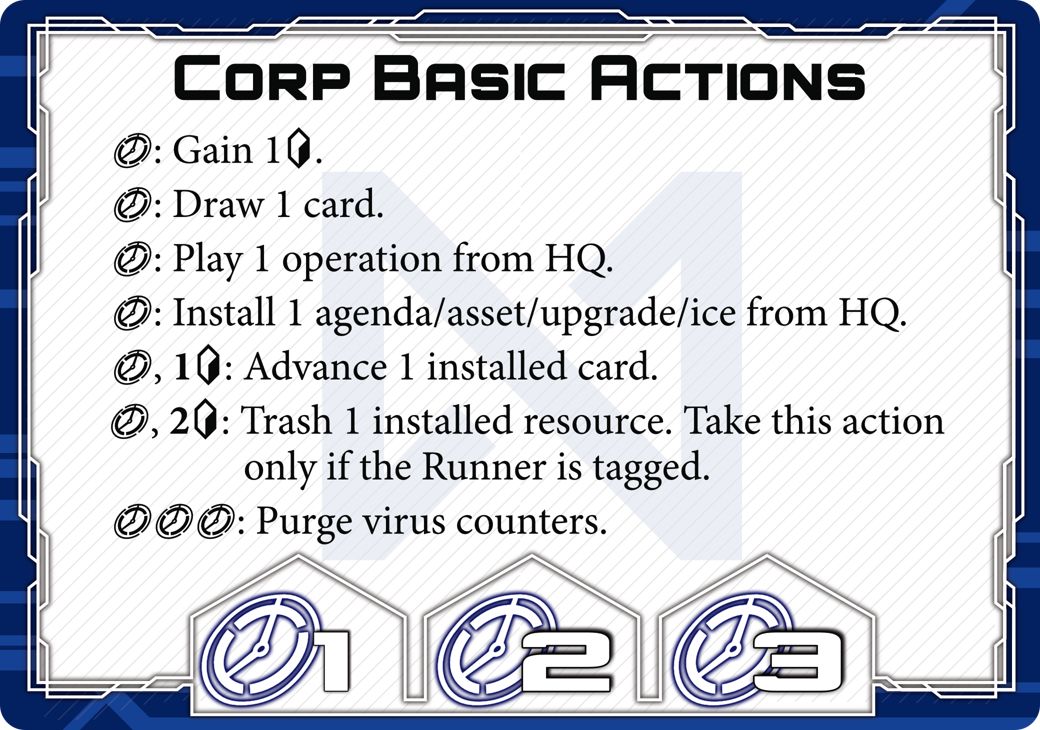
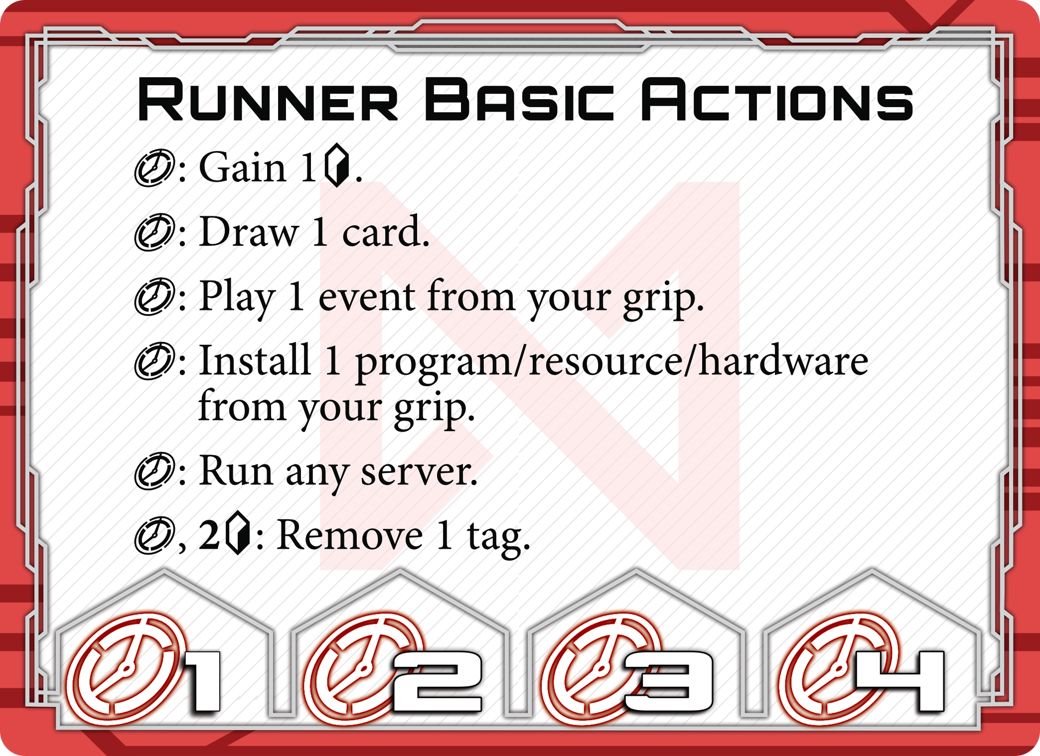
“Both players start with 5 (credits), which are currency, and draw 5 cards.”
Each player’s max hand size is 5, enforced only at end of their turn. Starting with The Corp, players can choose to take a mulligan, shuffling their hand back and drawing a new hand of 5 cards. For this script, we will keep the starting hands.
Corp Turn 1
Start: 5, 5 cards in HQ.
The Corp always takes the first turn.
The Corp starts their turn with 3 (clicks).
The Corp’s turn always starts with a Mandatory Draw step.
Mandatory Draw (Tithe).
1: Play Hedge Fund.
To play an Operation: spend a click, pay its play cost in credits, place it in the play area faceup, resolve the text, then put it in Archives.
The Corp pays 5 to play Hedge Fund and resolves the text to gain 9, for a net gain of 4.
“All Corp cards are installed facedown.”
2: Install Greenmail in a new remote server.
To install a card: Spend a click and place it facedown in the play area.
Installed cards remain installed unless trashed.
The Corp can install a single agenda or asset in a remote server.
Install Greenmail in a new remote server next to HQ.
3: Install Maskirovka protecting Greenmail.
Ice is a special card type that protects a server.
Ice is always installed horizontally in front of a server.
End: 9, 3 cards in HQ.
Runner Turn 1
Start: 5, 5 cards in HQ.
The Runner’s turn does NOT begin with a mandatory draw step.
Instead, the Runner starts with 4 (clicks).
1: (Basic Action) Run Remote Server.
A run is the Runner making an attempt to breach a server and access the cards inside.
To make a run: the Runner spends a click and chooses any server to run.
Corp Pays 3 to rez Maskirovka.
The Runner approaches the ice.
Normally, the Corp chooses whether or not to rez ice.
The Corp rezzes the ice by paying its rez cost in credits, permanently turning it faceup.
Rezzing cards does not cost clicks.
The Runner encounters the ice.
Subroutines on Maskirovka fire.
Gain 2.
End the run.
Subroutines are the effects of the ice, and are usually bad for the Runner.
The Runner has no tools to deal with ice, so the subroutines fire.
The first subroutine gives the Corp 2.
The second subroutine ends the run, the run is unsuccessful.
2: Play Jailbreak choosing R&D.
To play an Event: spend a click, place it in the play area faceup, pay its play cost in credits, resolve the text, then put it in the Heap.
The Runner can also make runs using run events, if an ability tells the Runner to make a run, they don’t have to pay any additional clicks to make that run.
Since there is no ice protecting the server, the run is automatically successful.
❗ Trigger Jailbreak to draw 1 card (Creative Commission).
Breach R&D.
When a run is successful, the Runner breaches the server.
A breach on R&D typically allows the Runner to access the top card of R&D.
In this case, Jailbreak allows the Runner to access the top two cards of R&D, one at a time.
To access a card from R&D the Corp shows it to the Runner, but the Corp does not look at it.
Access Offworld Office.
When the Runner accesses an agenda, they steal it.
Stealing agendas is how the Runner wins the game.
Offworld Office is moved to the Runner’s Score Area and is worth 2 agenda points.
Each player needs 7 agenda points to win.
Offworld Office only triggers when it is scored by the Corp, not stolen by the Runner.
Access Karunā.
Most of the Corp’s other cards, such as ice, do nothing when accessed other than give the Runner information.
The Runner simply says “No action.” to indicate they won’t do anything with the card they are accessing.
❗Trigger Zahya Sadeghi to gain 2.
Since the Runner accessed two cards during a run on R&D they gain 2.
Identity text is always active.
“All Runner cards are installed faceup and are paid for immediately.“
3: Install Telework Contract.
To install a card: spend a click, pay its install cost in credits, and place it faceup in the play area.
Resources are installed on the back row of the Runner’s play area.
The Runner follows the instructions on the card to place 9 from the bank on the resource.
4: Click Telework Contract.
Telework Contract gives the Runner an additional action they can use.
The Runner moves 3 from Telework Contract to their credit pool.
End: 9, 4 cards in Grip.
Corp Turn 2
Start: 8, 3 cards in HQ.
Mandatory Draw (Karunā).
1: (Basic Action) Pay 1 to advance Greenmail.
To advance a card: spend a click and a credit to place an advancement token on the card.
Conveniently, in most token sets an advancement token is just the back side of a credit token.
Only agendas and cards that explicitly say so can be advanced.
❗ Trigger Built to Last to gain 2.
The Corp’s Identity gives them 2 for advancing a card for the first time.
Identity text is always active.
2: (Basic Action) Pay 1 to advance Greenmail.
Score Greenmail.
Advancing and scoring agendas is how the Corp wins the game.
The advancement requirement of Greenmail is 2, found in the upper right corner.
Since it now has 2 advancement counters, it can be scored.
Scoring agendas doesn’t cost anything.
Greenmail is moved to the Corp’s score area and is worth 1 agenda point.
Each player needs 7 agenda points to win.
❗ Trigger Greenmail.
Greenmail gives the Corp 2 when scored.
Agendas can only be forfeited (removed from the game) if another card instructs you to.
3: Play Top-Down Solutions.
Draw 2 cards (Doomscroll and Whitespace).
Install Anthill Excavation Contract in the now empty Remote Server.
Install Whitespace protecting R&D.
End: 8, 3 cards in HQ.
Runner Turn 2
Start: 9, 4 cards in Grip.
1: Click Telework Contract.
2: Install Devadatta Drone.
Programs are installed on the front row of the Runner’s play area.
Devadatta Drone says to place 2 power counters on it when it is installed.
3: (Basic Action) Run R&D.
The Corp pays 2 to rez Whitespace.
Subroutines on Whitespace fire.
The Runner loses 3.
If the Runner has 6 or less, end the run.
The first subroutine causes the runner to lose 3.
The second subroutine will fire, but since the Runner still has 8 credits it will not end the run.
❗ Trigger Devadatta Drone.
The run is successful and the Runner breaches R&D.
The Runner chooses to spend a power counter from Devadatta Drone to access an additional card from R&D.
Access Brân 1.0.
The Runner takes “No action.” when accessing Brân 1.0.
The Corp must maintain the order of cards in R&D during accesses.
Access Anthill Excavation Contract.
Trash Anthill Excavation Contract.
Some Corp cards, like Assets, have a trash symbol () in the lower right corner.
The number in the symbol is the trash cost.
When accessing a card, the Runner can pay its trash cost in credits to trash it, moving it to Archives.
❗ Trigger Zahya Sadeghi to gain 2.
4: Draw 1 card (Rising Tide)
Both players have access to the basic action to click to draw 1 card.
End: 9, 4 cards in Grip.
Corp Turn 3
Start: 6, 3 cards in HQ.
The Corp Pays 3 to rez Anthill Excavation Contract.
Rezzing cards never costs clicks and can be done almost any time.
The Corp can rez non-ice cards before taking their mandatory draw.
This is the best time to rez cards that trigger “when your turn begins”.
Anthill Excavation Contract instructs the Corp to place 8 on it from the bank when rezzed.
❗ Trigger Anthill Excavation Contract to gain 4 and draw 1 card (Brân 1.0)
Mandatory Draw (Sprint).
1: Gain 1.
Both players have access to the basic action to click to gain 1.
2: Install Doomscroll protecting HQ.
3: Install Tithe protecting R&D, paying 1.
The Corp can install additional layers of ice.
The 1st layer of ice costs 0 to install.
The 2nd layer of ice costs 1 to install, at the time the ice is installed.
The 3rd layer of ice costs 2 to install, at the time the ice is installed.
And so on…
The Runner must pass all ice to breach a server, starting with the outermost ice.
Between pieces of ice, the Runner may “Jack Out” (abandon the run) before encountering the next ice.
End: 7, 3 cards in HQ.
Runner Turn 3
Start: 9, 4 cards in Grip.
1: Install Rising Tide.
2: (Basic Action) Run Remote Server.
The Runner breaks both subroutines on Maskirovka using Rising Tide for a total cost of 4.
Gain 2.
End the run.
The Runner can use icebreakers to break subroutines so they do not fire.
To Interface with Maskirovka, Rising Tide must meet or exceed the strength of Maskirovka.
The strength of a program or ice is the number in the grey circle.
Rising Tide is strength 1.
Maskirovka is strength 3.
The Runner activates the ability: “1: +1 strength” twice, paying 2.
Rising Tide is now strong enough to Interface with Maskirovka.
The Runner activates the “Interface →” ability: “1: break 1 barrier subroutine” twice to break both subroutines, paying 2.
This only works because Maskirovka has the barrier subtype.
The Runner can pick and choose which subroutines they want to pay to break.
The Runner passes Maskirovka because the “End the run.” subroutine is broken.
Icebreaker strength and broken subroutines reset after each encounter.
The Runner pays 1 to trash Anthill Excavation Contract.
3: (Basic Action) Run HQ.
The Corp pays 3 to rez Doomscroll.
Fire Subroutines on Doomscroll.
Give the Runner 1 tag.
Do 1 net damage.
Do 2 net damage if the Runner has at least 2 tags.
A tag is a status effect the Runner can have.
Thematically, a tag means the Corp knows the Runner’s physical location and can use this to hurt the Runner.
Certain effects are only enabled while the Runner is tagged, such as Doomscroll’s third subroutine or the Corp’s Basic Action to trash resources.
To take 1 net damage, the Runner shuffles their hand and presents it facedown to the Corp.
The Corp selects 1 card to trash from it at random.
This card is revealed and goes to the Heap.
“If the Runner takes more damage than there are cards in the Grip, the Runner is Flatlined and loses the game.“
Breach HQ.
To access cards from HQ, the Corp shuffles their hand and presents it facedown to the Runner.
The Runner selects 1 card to access from it at random.
This card is revealed to both players and set aside unless stolen or trashed by the Runner.
If the Runner was allowed to access more cards from HQ, they would continue one at a time, setting them aside until finished.
Then, all set aside cards not stolen or trashed are returned to HQ.
❗ Trigger Zahya Sadeghi to gain 1.
4: Pay 2 to remove 1 tag.
End: 2, 2 cards in Grip.
Closing Notes
- Reveal Urtica Cipher from the top of the Corp’s deck, shuffle the deck after.
Some Corp cards are ambushes and explicitly say they can be advanced.
The Corp can install and advance Urtica Cipher facedown, it will look just like an agenda to the Runner.
The Corp is hoping the Runner will spend resources accessing Urtica Cipher and potentially flatlining from the net damage it does.
If the Runner doesn’t fall for the ambush, the Corp can reuse the server for a new asset or agenda by first trashing the existing card.
This is called “overinstalling” the Urtica Cipher.
- There are three main subtypes of ice. One of each is currently installed and rezzed.
- Barrier (Maskirovka)
- Code gate (Whitespace)
- Sentry (Doomscroll)
- Each ice subtype has a corresponding icebreaker.
- Rising Tide can break barriers, but the Runner still needs to draw through their Stack to find two more icebreakers. One for sentries and one for code gates.
- In the unlikely case that the Corp is forced to draw a card from an empty R&D the Corp loses the game.
- There are no Upgrades or cards that give virus counters in these decks.
This concludes the script. Players are welcome to continue playing from this point or shuffle the decks for a new game.
Does the Runner have to break all the subroutines on an ice?
No, many subroutines, like on Doomscroll and Whitespace may have no effect at times.
The Runner may also decide it is better to allow a subroutine to resolve instead of paying to break it.
What happens if a player has more than 5 cards in their hand at the end of their turn?
That player discards cards until they reach their max hand size, which is usually 5.
Cards discarded by the Corp go to Archives facedown.
Cards discarded by the Runner go to the Heap faceup.
What happens when the Runner breaches Archives?
Archives is always there, and can be run, even if there are no cards in it.
When the Runner breaches Archives, first turn all facedown cards faceup, then the Runner accesses all of them. If any are agendas, the Runner steals them.
If the Runner plays Ritual as their first click what happens?
The Runner spends 1 click to play Ritual and draws 3 cards. Ritual only counts the Runner’s remaining clicks and does not spend them.
What is the small diamond (♦) in front of some card names?
This is the “unique” marker. Players cannot have two of the same unique (♦) card faceup at once.
If the Runner uses the basic action to draw ♦ Verbal Plasticity, installs it, then uses the basic action to draw again how many cards will they draw?
Only 1, the game keeps track of the “first time” something happens even if ♦ Verbal Plasticity wasn’t around to see it.
How does ♦ GAMEDRAGON™ Pro work?
Icebreaker strength usually resets at the end of each encounter. In addition to boosting an icebreakers strength +1 , the strength wont reset until the end of the run. If a server has multiple high strength ice of the same type, the Runner will save a lot of credits by not having to increase strength on the second ice.
What does “hosted” mean?
Some objects (such as hardware or counters) can be on top of another object. The object on the bottom is the “host” and the objects on top are “hosted”
How does Brân 1.0 work?
The Runner can spend clicks to break subroutines on Brân 1.0 without needing an icebreaker. Strength is irrelevant when using this ability (because it is not an “Interface →” ability).
One click is lost per subroutine the Runner wishes to break.
The Runner can still use Rising Tide to break Brân 1.0 normally.
How does Gourmand work?
Gourmand allows you to trash a card you are accessing even if it doesn’t have a trash cost.
This includes ice and Operations accessed from HQ or R&D.
Installed ice is encountered by the Runner, not accessed. Gourmand can NOT trash installed ice.
“Access →” on Gourmand means its ability can only be used when accessing a card.
How does Maintenance Access work?
Maintenance Access is a Double, so two clicks must be spent to play it. Since this is a cost, it cannot be played last click to avoid the extra click (like Creative Commission).
Maintenance Access gives the Runner a “backdoor” into HQ, they run Archives (which is hopefully un-iced) and it will be treated as a successful run on HQ. Zahya’s ability and Docklands Pass will work.
How does Urtica Cipher work?
Urtica Cipher will only damage the Runner while installed. If the Runner accesses Urtica Cipher while it is installed, they will take two damage plus 1 damage for each advancement counter on it.
Urtica Cipher does not have to be rezzed to do damage.
This damage cannot be avoided by trashing Urtica Cipher. The Runner usually does not bother to trash an installed Urtica Cipher, because they simply won’t run there again until the Corp “Over-installs” it with something new.
Can the Corp forfeit Greenmail to rez a Biawak when they have less than 4?
No, the Corp must have at least 4 to pay for Biawak because Greenmail will trigger after costs are paid.
Can the Runner use multiple copies of Devadatta Drone in one run?
Yes, each copy triggers separately allowing the Runner to spend up to one counter per copy.
How does Zahya Sadeghi: Versatile Smuggler work?
Zahya’s ability may only be used “Once per turn”. However, since it is a “may” ability, the Runner can decline to use it.
For example, if the Runner accesses 1 card from HQ, they might decline the 1 because they want to save the trigger for another run later that turn where they access 3 cards to gain 3.
Help, I ran out of Memory (, also called “MU”)!
When installing a new program, the Runner may first trash any existing programs to make space, this is called “Over-installing” the program. The most common situation this comes up in is getting rid of “used up” Devadatta Drones.
Why does NetrunnerDB say these decks are not Standard legal?
Influence limits were ignored while creating these decks in order to create a better learn to play experience. This also allowed us to showcase a little bit of each faction in the decks.
Additionally, cards in these decks may have been added to the standard ban list.
